Robotaxi governance
Robotaxis will make our cities better.
Jan 21, 2026
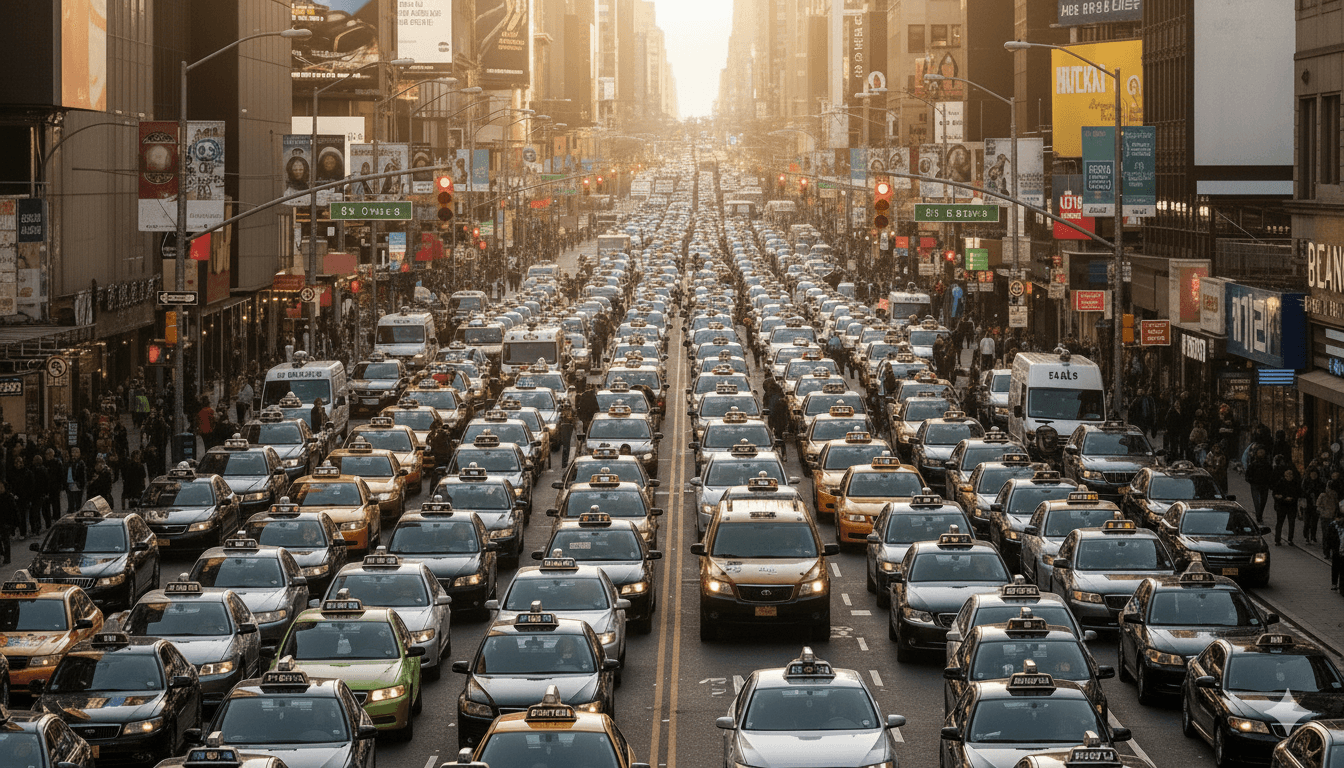
The unregulated scenario of a city overcrowded with robotaxis. We can do better than this.
Parked cars will be moved from the streets. Congestion will be diminished. All cars will be electric. People will start to walk & cycle more. Utopia? Nope. But we need to get the regulations right.
In the US and China, large fleets are already operating, and Europe is next in line. (Le Monde.fr) For a city with ambitions to be more people-friendly, this is a fork in the road:
Path 1: the car is getting even more more attractive, but more traffic, more competition with walking, cycling and transit, and vast numbers of empty vehicles circulating;
Path 2: fewer or no private cars, freed-up street space and shared robotaxis co-exist with high-capacity public transport.
Based on our own experiences with e-scooter mikado, we know how to tackle new fleets of mobility services entering cities - and turn them into good mobility services. Robotaxis are just the next wave.
The technology itself doesn’t decide which path you take. Your rules do.
Start from your city goals, not the vehicle
Cities already have clear ambitions:
reach climate targets and reduce car dependency
increase the share of trips made by walking, cycling and public transport
free up on-street parking for housing, trees, bike lanes and safer streets. Yes! More liveable cities.
ensure accessible mobility for everyone, including people with reduced mobility
Those goals should define what well-balanced robotaxi deployment looks like.
The International Transport Forum (ITF) famously showed that if all private car trips in Lisbon were replaced by shared vehicles integrated with high-capacity transit, only around 10% of today’s cars would be needed, and most on-street parking could disappear. (itf-oecd.org)
The same research also shows the flipside: if automation simply makes car travel cheaper and more convenient, traffic can increase, and active modes can decline.
So the question for your city is simple:
How do we design robotaxi rules so we move toward the “Lisbon 10% of cars” scenario?
Make all AVs shared
Unregulated, AVs risk pulling people away from buses, trams, walking and cycling, and increasing vehicle-kilometres travelled (VKT) by 10–50% or more.
Your permits should therefore:
Prioritise shared robotaxis over private AVs. Solo, privately owned AVs are the fastest route to more traffic, not less.
Tie operating rights to support public transport. Allow more vehicles – and better access – only where operators feed passengers into rail, metro, tram and high-frequency bus corridors. AVs should complement public transport, instead of competing with them.
NACTO’s Blueprint for Autonomous Urbanism argues for exactly this people-first hierarchy: walking, cycling and transit first, with AVs designed to fit into that structure, not replace it. (NACTO)
Give robotaxis a dynamic license to operate
The core principle is straightforward:
No digital compliance, no access.
Any operator using your streets should accept that their permit is dynamic and data-driven:
Mandatory data sharing (with strong privacy protections) so you can see what is happening to vehicle kilometers travelled, mode share, policy compliance and space use.
Mandatory compliance with machine-readable rules for where, when and how services can run. And yes, they will be updated in real-time.
Performance-based access: if the data show that robotaxis are reducing private car use and supporting walking, cycling and transit, they can scale up; if not, you tighten the rules.
This is the same logic San Francisco’s County Transportation Authority is exploring for AV permitting: access rights linked to safety and performance metrics, not one-off approvals. (SFCTA)
Focus your rules on the whole system, not just the curb
Curb rules still matter, but the real win is on the system level: fewer vehicles, fewer kilometres driven, more space for people.
Here are three high-impact levers:
1. Use pricing to steer behaviour, not to fill the budget
Pricing is one of your strongest tools to reduce unnecessary traffic:
Per-kilometre fees that rise with distance, especially during peaks..
Higher fees for empty repositioning and solo rides;
Discounts for shared rides and trips that connect to stations or replace car-dependent commutes (not short inner-city trips that could be walked or cycled).
Evidence from AV and ride-hailing studies shows that, without such controls, cheaper, more convenient car-like travel draws people away from transit and active modes. Targeted incentives can reverse that tendency.
2. Protect and expand walking and cycling
AVs will often be promoted as “safer than humans” – and early insurance data from operations like Waymo suggest large reductions in crash claims per mile compared to human drivers. (The Verge)
But the real transformation comes when you use the space they free up:
commit that any parking space made redundant by robotaxi deployment is reallocated to sidewalks, bike lanes, trees, bus lanes or public space, not more driving lanes;
designate low-traffic neighbourhoods and cycle priority streets where robotaxis are limited, slowed or excluded altogether;
use AV rules to calm traffic around schools and high-injury streets, with lower speeds and fewer vehicles.
The ITF Lisbon work highlights that removing most on-street parking could dramatically improve conditions for walking and cycling and make these modes more attractive. (OECD)
3. Integrate robotaxis into public transport
For medium to larger cities, the backbone is usually a mix of regional rail, tram/BRT and strong bus routes. Robotaxis should fill gaps in that network:
connect poorly served neighbourhoods to nearest hubs;
guarantee late-night or weekend coverage where fixed routes are sparse;
offer on-demand services for people with reduced mobility on top of the standard network.
ITF modelling finds that the biggest vehicle-reduction benefits appear when shared on-demand services are combined with high-capacity public transport, not when they try to replace it. (itf-oecd.org)
Robotaxis, a tool for effective policies
With the right dynamic governance in place, robotaxis can support our cities goals.
Used poorly, they will just be one more way to sit in traffic.
Used well, they can help us cut the number of vehicles on the road, push electrification, reclaim space for people and accelerate the shift to walking, cycling and public transport - for healthier, more liveable cities.